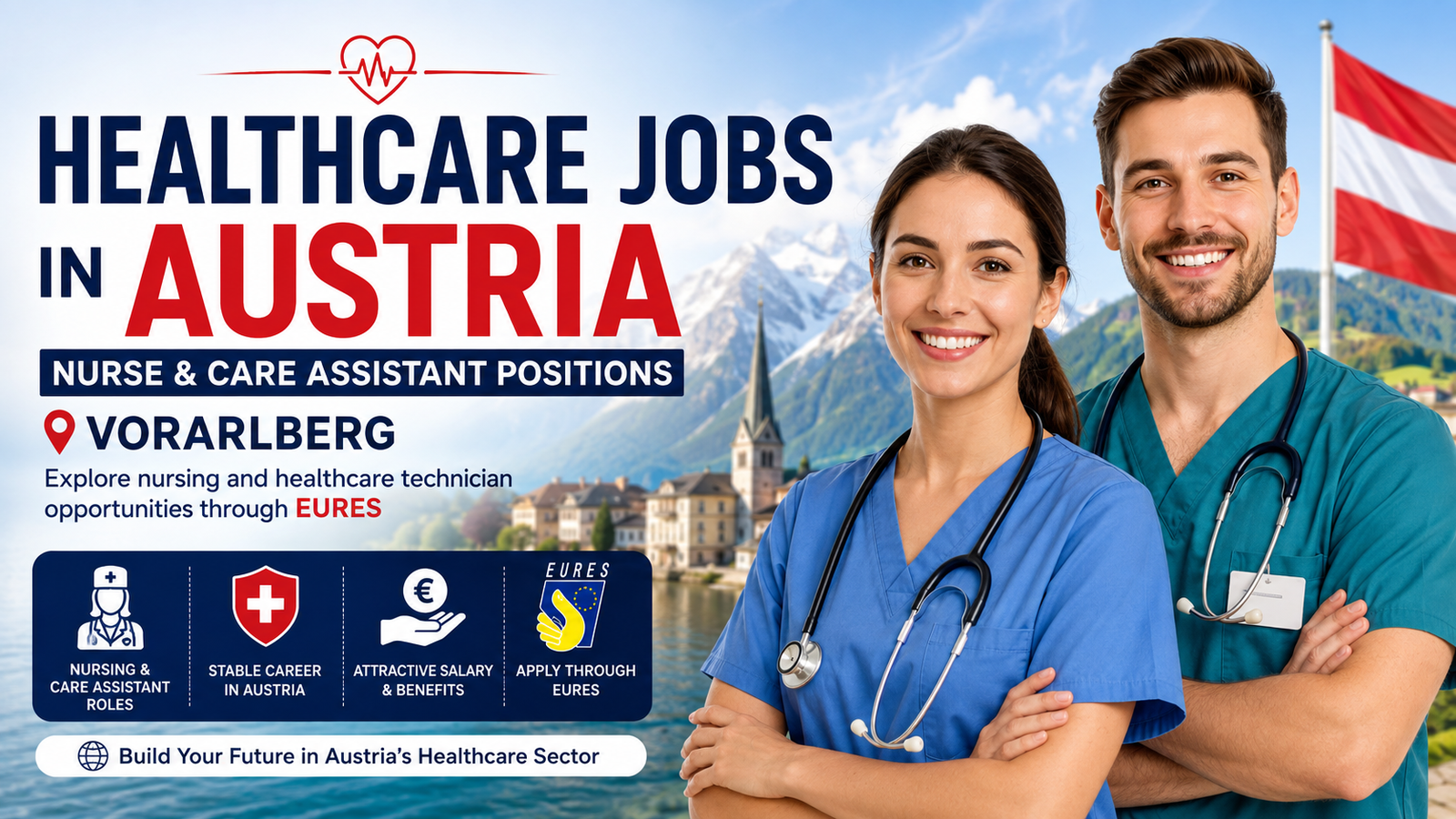
Healthcare Technician Jobs in Vorarlberg, Austria – Nursing & Care Support Positions
Long-term healthcare employment opportunity in Austria’s premier Alpine region
Quick Job Overview
| Field | Details |
|---|---|
| Job Title | Nurse / Healthcare Technician / Care Assistant |
| Employer | Atria Projektagentur |
| Country | Austria |
| City/Region | Vorarlberg |
| Employment Type | Full-time |
| Contract Type | Long-term |
| Salary (Monthly) | €2,785 – €3,560 (Net pay) |
| Experience Required | Not specified in the original vacancy |
| Language Requirement | German (Fair/B1 level) or Spanish (Fluent/C1 level) |
| Positions Available | 4 positions |
| Source | EURES – European Job Days (Make it in Germany 2026) |
| Last Verified | August 2026 |
1. Job Overview
The Austrian healthcare sector is seeking qualified nursing professionals to join healthcare delivery teams in Vorarlberg, one of Austria’s most progressive and well-established healthcare regions. This position offers an excellent opportunity for healthcare professionals who are passionate about delivering high-quality patient care and supporting vulnerable populations, particularly in older care services.
Atria Projektagentur, a healthcare staffing organization, is actively recruiting nursing professionals, healthcare technicians, and care assistants to strengthen its teams across Vorarlberg. These positions form part of a broader European healthcare recruitment initiative, highlighting Austria’s significant demand for trained healthcare workers as the population ages and healthcare facilities expand their capacity.
The role is designed for compassionate healthcare professionals who enjoy providing direct patient care, supporting individuals in their daily living activities, and working within structured healthcare environments. Vorarlberg, nestled in the Austrian Alps near Switzerland and Liechtenstein, is known for its excellent healthcare infrastructure, high quality of life, and strong worker protections.
Employment is offered on a full-time, long-term basis, providing career stability and the opportunity to build a sustainable healthcare career in one of Europe’s most stable economies. The position suits candidates with various levels of healthcare experience, from newly qualified professionals to experienced care workers, depending on the specific role assigned within the employer’s network.
2. About the Employer
Atria Projektagentur is a healthcare recruitment and staffing specialist operating across Austria and participating in pan-European healthcare mobility initiatives. The organization focuses on matching qualified healthcare professionals with facilities and employer organizations that require healthcare services, particularly in older care, nursing, and healthcare support roles.
As a participant in the Make it in Germany and broader EURES recruitment events, Atria Projektagentur demonstrates commitment to supporting European labor mobility and filling critical healthcare workforce gaps across Alpine and Central European healthcare systems. The organization works within established frameworks for healthcare professional recognition and supports international healthcare workers in navigating qualification recognition and workplace integration.
Vorarlberg, where this position is located, is Austria’s westernmost federal state and is recognized for its progressive healthcare sector, modern medical facilities, and strong commitment to employee welfare. The region’s healthcare system emphasizes quality care, professional development, and worker protection.
3. About the Job
This nursing and care assistance position involves providing direct patient or resident care in Austrian healthcare settings, likely within older care facilities, nursing homes, or hospital environments. The role contributes to maintaining the health, dignity, and well-being of individuals who require nursing support, whether through long-term residential care or acute healthcare settings.
Responsibilities typically include assisting patients with activities of daily living, monitoring vital signs or health status as appropriate to the role level, supporting medical staff in healthcare delivery, maintaining a clean and safe care environment, and communicating effectively with patients, families, and the healthcare team. The specific scope depends on the candidate’s qualifications and the employing facility’s needs.
Working in Vorarlberg means joining a healthcare system renowned for modern facilities, established protocols, and professional working conditions. The region benefits from Austria’s universal healthcare system and strong workplace protections, ensuring that healthcare workers operate within well-regulated environments with clear professional standards.
4. Key Responsibilities
- Patient Care Provision: Delivering direct, hands-on care to patients or residents, assisting with personal hygiene, mobility, and activities of daily living in accordance with care plans and individual requirements
- Health Monitoring: Observing and reporting on patient or resident health status, assisting with vital sign monitoring, and communicating changes in condition to nursing staff or physicians
- Care Documentation: Maintaining accurate records of care provided, patient observations, and any incidents or changes in health status, ensuring compliance with Austrian healthcare documentation standards
- Infection Control and Hygiene: Maintaining strict standards of cleanliness and infection prevention within the care environment, following established healthcare protocols and regulations
- Team Collaboration: Working cooperatively with nurses, physicians, care coordinators, and other healthcare professionals to deliver integrated, person-centered care
- Patient Advocacy and Communication: Responding to patient or resident needs, maintaining respectful and empathetic communication, and advocating for patient comfort and dignity
- Facility Support: Contributing to the maintenance of a safe, organized, and welcoming care environment, including equipment management and adherence to safety protocols
- Continuing Professional Practice: Staying current with workplace procedures, participating in orientation or training as required, and demonstrating commitment to professional development
5. Qualifications and Education
Required Qualifications
A recognized nursing qualification, healthcare technician certification, or care assistant qualification from your home country or from Austria. Qualifications must be appropriate to the specific role (nurse, technician, or care assistant).
For international candidates, qualification recognition is an important consideration. Austria requires that healthcare qualifications be formally recognized or assessed. The process for recognizing foreign nursing qualifications in Austria involves application to the relevant state authority and may include documentation review, language assessment, or supplementary training.
Preferred Qualifications
Previous experience in healthcare settings is likely to be valued, though the vacancy does not explicitly state that experience is mandatory. Candidates with demonstrated healthcare experience, familiarity with European healthcare standards, or prior work in similar facilities may find the application process more straightforward.
6. Experience Requirements
This information was not specified in the original vacancy.
The vacancy does not indicate whether a minimum period of healthcare experience is required. This suggests that the employer may consider candidates at various career stages, from newly qualified healthcare professionals to experienced care workers. Candidates without previous work experience who hold appropriate qualifications should not assume they are ineligible; however, they should verify experience expectations when applying.
7. Required Skills
Technical Skills
- Patient care delivery – Practical ability to provide or assist with nursing care, personal support, and daily living assistance
- Health observation – Capacity to monitor patient or resident status and recognize changes in health or well-being
- Healthcare documentation – Familiarity with care records, reporting systems, and healthcare information management
- Infection control – Understanding and application of hygiene and infection prevention protocols
Professional Skills
- Teamwork and collaboration – Ability to work effectively within multidisciplinary healthcare teams
- Adaptability – Responsiveness to different patient or resident needs and changing care requirements
- Time management – Organizing care tasks and responding to multiple care demands efficiently
- Problem-solving – Managing practical challenges that arise in healthcare settings
Communication Skills
- Empathetic communication – Ability to communicate respectfully and compassionately with patients, residents, and families
- Professional communication – Clear and accurate reporting to healthcare professionals and colleagues
- Multilingual capability – Fluency in German (B1 CEFR level) or Spanish (C1 CEFR level)
8. Language Requirements
The vacancy explicitly states that either German (Fair proficiency level / CEFR B1) or Spanish (Fluent proficiency level / CEFR C1) is accepted.
German at CEFR B1 level means you can understand the main points of clear standard input, handle most situations that arise while working, and produce simple connected text on familiar topics. In a healthcare context, this enables communication with patients, colleagues, and supervisors on routine clinical and workplace matters.
Spanish at CEFR C1 level (fluent/advanced) indicates professional proficiency, permitting you to understand a wide range of demanding texts, express yourself spontaneously without searching for words, use language flexibly for social, academic, and professional purposes.
9. Driving Licence Requirements
Driving licence requirements were not specified in the vacancy.
For on-site healthcare facility work in Vorarlberg, a driving licence may not be essential, as healthcare facilities typically have established transport and commuting arrangements. However, candidates should clarify with the employer whether personal transportation is expected.
10. Salary and Compensation
Monthly Net Salary: €2,785 – €3,560
The vacancy specifies a monthly salary range provided in net pay (meaning after tax and social security contributions). This represents the amount you will receive directly in your bank account.
The variation within the salary range may reflect different factors, such as experience level, qualification level (nurses vs. care assistants), shift patterns, or probationary periods.
Additional compensation details were not specified in the original vacancy. Candidates should verify whether the salary range includes or excludes any bonuses, shift differentials, holiday pay, or other allowances by contacting the employer directly.
11. Working Hours and Employment Conditions
Weekly hours and specific shift patterns were not specified in the original vacancy.
The vacancy indicates full-time, long-term employment, which in Austria typically means a minimum of 38–40 hours per week, though exact working hours are not specified.
Healthcare facilities often operate 24/7, which may involve shift work, weekend availability, or variable scheduling. Candidates should confirm the specific shift patterns, weekend requirements, and schedule arrangements when contacting the employer.
12. Benefits and Additional Conditions
Additional benefits were not specified in the original vacancy.
Standard Austrian employment benefits typically include:
- Statutory health insurance (included in social security contributions)
- Pension/retirement contributions (compulsory)
- Paid annual leave (minimum 20 days per year under Austrian law)
- Sick leave protection (statutory)
- Workplace accident insurance (compulsory)
13. Visa and Work Permit Information
EU/EEA Applicants
If you are a citizen of an EU or EEA country (including Switzerland), you have the right to work in Austria without requiring a visa or work permit. You can move freely to Austria and begin employment once you have completed necessary employment registration with local authorities.
Non-EU Applicants
If you are a citizen of a country outside the EU/EEA, visa and work permit requirements apply. Austria requires non-EU workers to secure a work permit (Arbeitserlaubnis) and an employment visa or residence permit.
The vacancy does not state that visa or work-permit sponsorship is provided. Non-EU applicants should verify directly with the employer whether sponsorship support is available.
14. Who Can Apply?
Based on the verified vacancy information, the following candidates may be eligible:
- Healthcare professionals – Nurses, healthcare technicians, or care assistants with recognized qualifications
- Language speakers – Candidates fluent in German (B1 CEFR level) or Spanish (C1 CEFR level)
- Full-time workers – Those available for long-term, full-time employment
- EU/EEA citizens – Those with unrestricted work authorization in Austria
15. Documents Required
The vacancy does not provide a detailed list of required documents.
However, standard documentation typically required for healthcare employment in Austria includes:
- CV in English or German – Detailing your healthcare experience and qualifications
- Qualification certificates – Original or certified copies of your nursing or care assistant qualifications
- Language certificates – Evidence of German (B1) or Spanish (C1) language proficiency
- Professional references – Contact details for previous employers or supervisors
- Identification documents – Passport or national ID
- Police conduct certificate or background check – Often required for healthcare roles
16. Selection Process
The vacancy does not provide complete details about the selection process.
Typically, healthcare recruitment through EURES involves:
- Application screening – Review of submitted CV and qualifications
- Initial contact – Employer or recruiter contacts shortlisted candidates
- Language assessment – Verification of German (B1) or Spanish (C1) proficiency
- Interview – Likely conducted by phone, video, or in-person
- Qualification verification – Confirmation of healthcare credentials
- Final offer – Employment contract and start date discussion
17. How to Apply
To apply for this nursing position in Vorarlberg, Austria, follow these steps:
18. Job-Seeker Preparation Guide
Preparing Your CV for Austrian Healthcare Employment
Austrian employers expect CVs that are clear, chronological, and focused on relevant experience. Include your full healthcare employment history, emphasizing patient care experience, team leadership roles, and specialized certifications. Consider translating your CV into German if you have strong language skills.
Demonstrating Language Proficiency
Language ability is essential for patient safety and team communication. Obtain formal language certificates (such as CEFR certification) if you haven’t already, as this strengthens your application.
Highlighting Relevant Healthcare Experience
Prioritize any experience in older care, nursing homes, hospital settings, or direct patient care roles. Emphasize your experience with multidisciplinary teams and adherence to healthcare protocols.
Addressing Qualification Recognition
If your healthcare qualification is from outside Austria or the EEA, research Austria’s qualification recognition procedures in advance and indicate in your application that you are prepared to undergo assessment if required.
Preparing for Interviews
Anticipate questions about your patient care philosophy, experience with diverse populations, conflict resolution in healthcare teams, and why you are interested in working in Austria. Practice communicating your healthcare experience clearly in German or Spanish.
19. Location and International Applicant Guide
Vorarlberg, Austria – The Workplace Location
Vorarlberg is Austria’s westernmost federal state, located in the Alpine region between Switzerland, Liechtenstein, and eastern Austria. The region has a population of approximately 400,000 and is known for its picturesque mountain landscapes, progressive economy, and high quality of life.
Healthcare Infrastructure and Work Environment
Vorarlberg maintains modern healthcare facilities and a well-established healthcare system aligned with Austrian standards. The region’s healthcare employers are recognized for professional working conditions, adherence to European labor law, and commitment to staff development.
Language and Integration
German is the primary language, though Vorarlberg has an established Spanish-speaking community. Austria generally welcomes international workers, particularly in healthcare, and many workplaces actively support integration.
Social Support and Employment Protections
Austria offers strong worker protections under its employment laws, including statutory leave, sick leave, pension contributions, and health insurance. Healthcare workers benefit from established professional standards, union representation opportunities, and ongoing professional development support.
20. Frequently Asked Questions
What is the job title, and what does it involve?
The position is for a Nurse, Healthcare Technician, or Care Assistant in Vorarlberg, Austria. The role involves providing direct patient or resident care, supporting individuals with activities of daily living, monitoring health status, and working within multidisciplinary healthcare teams. Specific duties depend on your qualifications and the employing facility’s needs.
Where is the job located?
The position is in Vorarlberg, Austria’s westernmost federal state, located in the Alpine region near the Swiss and Liechtenstein borders. Vorarlberg is known for modern healthcare facilities and a high quality of life.
What is the salary?
The monthly net salary (take-home pay) is €2,785–€3,560. This is the amount you receive after tax and social security contributions. Gross salary (before deductions) will be higher.
Is previous experience required?
This information was not specified in the original vacancy. The position may be open to candidates at various experience levels, from newly qualified healthcare professionals to experienced care workers. Contact the employer to clarify experience expectations.
What qualifications are required?
You must hold a recognized nursing, healthcare technician, or care assistant qualification. If your qualification is from outside Austria or the EEA, it must be formally recognized or assessed by Austrian authorities.
What language is required?
You must speak either German at CEFR B1 level (fair proficiency) or Spanish at CEFR C1 level (fluent/advanced proficiency). Language proficiency is essential for patient safety and team communication.
Is a driving licence required?
Driving licence requirements were not specified in the vacancy. Contact the employer to confirm whether personal transportation is necessary for the specific facility location.
Is visa sponsorship available?
The vacancy does not state that visa or work-permit sponsorship is provided. EU/EEA citizens can work freely in Austria. Non-EU citizens must verify sponsorship availability with the employer and understand that work permits are required before employment can begin.
How long is the contract?
This is a full-time, long-term employment position, providing employment security and the opportunity to build a sustainable healthcare career in Austria.
How do I apply, and what is the deadline?
Apply through the EURES European Job Days platform (Make it in Germany 2026 event) or contact Atria Projektagentur directly. The application deadline was not specified in the original vacancy, so apply promptly as positions may be filled quickly.
Ready to Apply?
Don’t miss this opportunity to advance your healthcare career in Austria’s progressive healthcare system.
💡 Tip: Use the EuropePass CV Builder to create a professional resume tailored to the Austrian healthcare sector. Ensure your qualifications and language proficiency are clearly documented.
21. Source, Verification and Disclaimer
Original Source: European Job Days – Make it in Germany 2026 Event (EURES Network)
Employer: Atria Projektagentur
Official Vacancy Reference: Nurse / Healthcare Technician / Care Assistant – Vorarlberg, Austria
Original Posted Date: Event running through June 2026
Last Verified: August 2026
Application Channel: EURES European Job Days Platform (europeanjobdays.eu)
Official Website: https://europeanjobdays.eu/en/make-it-2026